Zarosian Empire
This copy was last processed on . The copied wiki revision is dated .
| Zarosian Empire | ||||
|---|---|---|---|---|
| Released | 9 July 2003 (Update) | |||
| Also called | ||||
| Members | No | |||
| Capital | Senntisten | |||
| League region | N/A | |||
| Inhabitants | Mahjarrat, Humans, Vampyres, Demons, Dragon riders, Sirens | |||
| Advanced data | ||||
| Type | region | |||
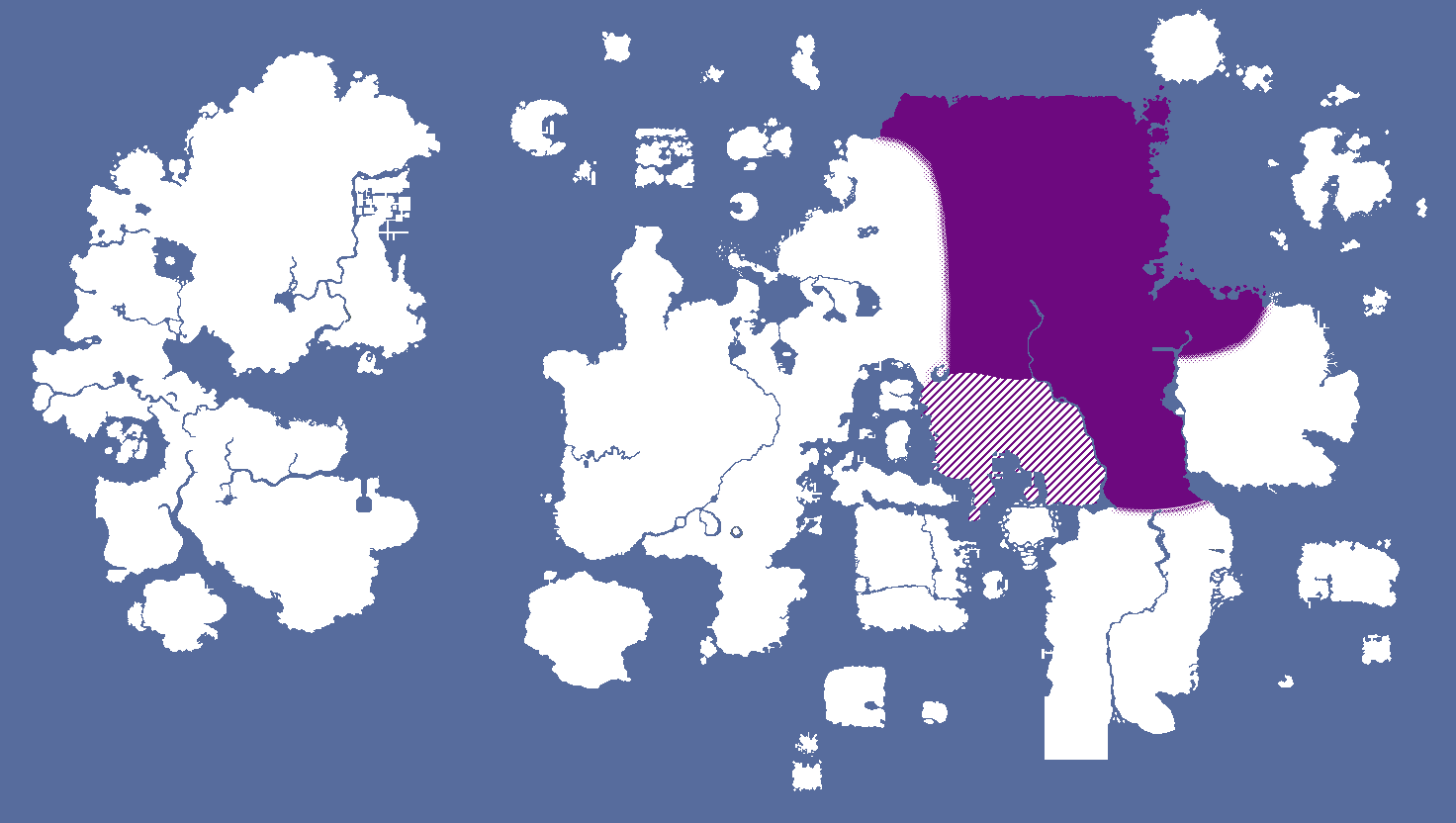
The Zarosian Empire was a vast ancient empire that covered the territories of where Misthalin, Asgarnia, the Wilderness, and north-western Morytania now stand.[3] Zaros founded the Empire expeditiously after his arrival on Gielinor. It was the predominant force during the Second Age and the beginning of the Third Age.
The fall of the Empire was instigated when Zaros was betrayed by Zamorak, which banished Zaros from Gielinor. The God Wars ensued, in which the Empire was destroyed. Saradomin and Zamorak attempted to remove all traces of the Empire after its fall. Today, only its ruins remain as evidence of its existence. The Empire was ruled by the god Zaros himself, presumably from the capital city of Senntisten which was located east of Varrock where the Digsite can be found today. Recently, archaeological discoveries at the Digsite have ignited interest in Zarosian history and culture.
History
The history of the Empire can be divided in three parts. The dawn, peak, and fall of the Empire. Not much is known about the dawn and rise of the Empire, due to the fact that Saradomin and Zamorak tried to erase all that was Zaros.[4] More information is available about the fall of the Empire, for example due to Saradominists and Zamorakians’ documentation of events.
The Dawn of the Empire
The dawn of the Empire of the Empty Lord may not have been the reason the First Age ended as much as it marks the beginning of the Second Age. Zaros saw that the lands of Gielinor were vast and unspoiled, he then brought with him various races, including the powerful Vampyres, to Gielinor.[5][6] He introduced them the concepts of civilization (complex society)[7] and sovereignty (absolute authority of a territory).[8] The rapid expansion of the Empire could be explained by the fact that there were no competitors. This could have resulted in the swift settlement of the vast and unspoiled lands, however the details of the Empire’s early days and initial rise, largely remain a mystery, for now.
The Peak of the Empire
Territory
Little is known about how, at what pace, and in which order, the Empire grew. One of the driving factors for growing into the largest Empire the world of Gielinor has ever seen, could be due to the fact that so many different races were admitted into Zaros’ Empire, Mahjarrat, demons, vampyres, dragon riders, and even humans.[9] At its peak the Empire spanned across, what currently is known as the Kingdom of Asgarnia, the Kingdom of Misthalin, Al Kharid, the North, the Wilderness, and the north-western corner of Morytania. The Empire predates all of these names, back then, the two Kingdoms were not established yet and Al Kharid was called Kharid-et under Zaros’ rule. The Wilderness was known as Forinthry,[10] which was covered in dense forests, not desolate and barren like the Wilderness today.[11][10] There is actually no evidence of the Empire's presence south of White Wolf Mountain or south-west of the River Lum, however it is believed these lands were under Zarosian control, as there is no evidence of any other force being present as well. Lastly, the name Morytania did not exist in the Second Age. In the north-eastern corner, where current Canifis is, was a fortress called Kharyrll.
Borders
Who or what bordered the Empire during its reign is partly still a mystery. However, it is certain that the Empire bordered Hallowvale to the east,[12] in present day Morytania. In Acolyte Otrava's book 'Bloody notes' it becomes apparent that the author is a follower of Saradomin and lived in Hallowvale.[13] They describe the prediction and actual fall of Kharyrll, which at that time was still under Zarosian control.[14] This can be deduced from Zarosian warlock Xazyd Wier his journal, in which he recalls how he fled the fortress of Kharyrll whilst Zamorakian forces laid siege to it.[15]. However, due to how there was more than one notable siren amongst the ranks of the Zarosian Empire, it is possible that there may have been Zarosian settlements as far east as the Wushanko Isles.
To the south, the Empire's border was marked by the fortress of Kharid-et, overlooking the Kharidian Lands region.[16]
Although the exact western boundary of the Empire remains uncertain, Ghorrock in the Northern lands is believed to have been the westernmost fortress.
The Fall of the Empire
The Betrayal
The beginning of the end started with the dissent among the followers of Zaros.[17] The true nature of the dissent is up for debate, however there are a few indisputable facts. Zaros had allied himself to all sorts of dark and evil creatures that had it in their nature to betray.[18] Zaros was more powerful than any other god when the Empire was at its peak.[19] The dissent had grown into an actual plotting to overthrow Zaros,[20] especially amongst the Mahjarrat, who felt that their conditions under Zaros had not improved after being liberated from Icthlarin.[21] The group that was plotting the betrayal was led by a mahjarrat, Zamorak.[22] He had gathered his most trusted compatriots, namely Hazeel, Drakan, Thammaron, Zemouregal, and Viggora, who were promised to be given a large piece of land if they would succeed.[23] Zamorak suddenly came in the possession of the Staff of Armadyl, through a series of coincidences and sheer luck,[24] giving the group an actual opportunity to overthrow Zaros. Zamorak stabbed Zaros in the back with the Staff of Armadyl, and in the struggle that followed, Zaros fell in such a way that the staff sunk deeper into his body whilst simultaneously impaling Zamorak.[25] This caused Zamorak to ascend to godhood[26] and Zaros to fade from Gielinor completely.[27]
The Collapse
Zamorak was banished by the other gods for slaying one of their kind. However, Zamorak returned to Gielinor after 18 years, having become a god and grown stronger than ever.[28] A power vacuum had emerged due to the Empire being rudderless after Zaros’ banishment; a collapse was unavoidable with the Empire being vulnerable and defenceless.[29] Though, this chaos did not stop the Zarosians from fighting fiercely to keep the Empire alive.[30][31] Among the loyal Zarosians was Zaros’ strongest weapon, Nex. She lead a great army and tried to restore the Empire.[32] The forces of Saradomin realised the threat Nex posed and captured her and her army in the set of caverns that are now known as the God Wars Dungeon.[33] However, a Zarosian Mahjarrat by the name of Sliske managed to liberate Nex with a ruse and deception.[34] The other four armies reacted by temporarily joining forces to once again imprison Nex.[35][36] With Zaros’ strongest weapon and a significant army gone, it was only a matter of time before the Empire was conquered by the other gods.
The Destruction
There is no coherent documentation of how exactly the Empire chronologically perished out of existence. However, it is important to note that it has been established that the penultimate settlement to fall was the capital city of Senntisten[37] and the last Zarosian bulwark to succumb was Kharyrll.[38] For the other cities and settlements, an informed hypothesis can be made with the available sources. Presumably the cities, settlements, and fortresses in Forinthry were the first to be destroyed, conquered or both. The reasoning behind this hypothesis is, firstly, the fact that the other gods had each an army near the area currently known as the God Wars Dungeon to capture Nex and thus could have started conquering Forinthry from this location.[36] Secondly, the only record of this period is a text written by a Dragon rider who first reminisces about of the Battle of Carrallanger and then describes fleeing from another Zarosian named Corveth into the deep forests of Forinthry to find shelter in one of the older temples and forgotten shrines.[10] This alludes to the fact that the Forinthry settlements were among the first to have fallen. Thirdly, it is very probable that the Empire was conquered from its border (Forinthry and Lassar) towards its interior where Paddewwa geographically would have then functioned as a shield for Senntisten and then from this point recorded history resumes.
Ultimately Senntisten was conquered by the forces of Zamorak, who kept the name for the city.[39] The Zarosians that had survived the siege of Senntisten were driven into the Kharidian Desert,[40] where Zaros’ greatest hero, Azzanadra, was imprisoned in the Jaldraocht Pyramid.[41][42] With this final act the permanent exile of (the Zarosian) people ended,[43] their lands, homes, and lives stolen.[44]
Aftermath of the Empire
Remnants of the Zarosian Empire were scattered across Gielinor; the Mahjarrat Jhallan and Mizzarch relocated to Ghorrock, which was spared from destruction, likely as a result of its extreme distance from the rest of the empire. Duke Sucellus, the leader of the Sixth Legion, also relocated there, but soon became insane and ate its inhabitants to grow in size and power, believing that he was the one destined to restore the empire. This resulted in the two Mahjarrat evacuating the fortress and sealing it, leaving Sucellus into a deep slumber as he ran out of beings to consume. In Lassar, Sliske ordered the Whisperer to remove the seals surrounding the ancient pillar that was found in the undercity after she ordered the city sealed, resulting in its inhabitants dying or going insane from the shadows, including herself.
The Zarosian Mahjarrat, with their numbers and support dwindling, would still continue to work for Zaros' cause. A human adventurer would make contact with Azzanadra, freeing him from his prison as he began to search for any allies that he could in the present era.
Nex and her subordinates were busy working to secure the Mahjarrat ritual site for the Zarosians. Nex, who grew in strength, became nearly unstoppable, but the Saradominsts managed to trap her and her army in an icy cavern and put them into an enhanced sleep. Many years later, a group of aviansie, who were bringing a godsword blade that could kill gods, were ambushed by Zamorakian demons, prompting Bandosian and Saradominist reinforcements to arrive. However, infighting among the alliance resulted in a free-for-all for the godsword. During this time, a group of Saradominist priests began to grow weary of the war, such as Ashuelot Reis. They were approached by a former Saradominst who had converted to Guthixian, who gave them instructions to perform a ritual that would awaken Guthix. Instead, the ritual brought Nex and her army back from their slumber, and the priest in question was actually Sliske. Nex and her army began decimating the battlefield, resulting in a temporary truce between the four factions to seal Nex and her army back in their prison, though the magical protections that contained them could not be fully restored.[45]
Citizens
Races
The Zarosian Empire was very diverse in terms of its citizens and army. The following races were some of the Empire's inhabitants.
Interestingly, unlike in current Morytania, Humans and Vampyres coexisted.[47] The Zarosian army consisted predominantly of Mahjarrat, Vampyres, Demons, and Dragon riders, whereas Humans were scarce in the army.[9] The army became known as the Servants of the Ruinous Powers.[49]
Notable Citizens
- Azzanadra, a Mahjarrat, Pontifex Maximus of the Zarosian church, remained loyal to Zaros and fought for the survival of the Empire until the bitter end.[50]
- Hannibus, a Dragon rider, held the title of Venator Maximus. Disappeared shortly after the God Wars started.
- Lowerniel Drakan, a vampyre, Legatus in the Zarosian army. Betrayed Zaros by allying with Zamorak.
- Nex, a Nihil, Legatus in the Zarosian army, who was labelled as Zaros' most powerful weapon.[32]
- Perseriya, a siren, Praefectus Classis or Admiral of the Zarosian fleet at some point during the Third Age.
- Sliske, a Mahjarrat, convinced the other Mahjarrat to switch sides during the Kharidian-Zarosian War, also responsible for freeing Nex.[34][46]
- Duke Sucellus, a Chthonian demon, Legatus of the army, acting Legatus Maximus as of the Third Age.
- Vardorvis, a vampyre, Carnifex Maximus or chief executioner.
- Viggora, a human, only human to have ever held the position of Legatus in the Zarosian army. Betrayed Zaros by allying with Zamorak.
- The Whisperer, a siren whose real name is classified, an assassin who was tasked with collecting rare and powerful items and bringing them to the Ancient Vault.[51]
- Zamorak, a Mahjarrat, Legatus Maximus of the Zarosian army, betrayed Zaros and instigated the Fall of the Empire.
Technology
Metallurgy
Not much is known about Zarosian metals, but they made use of chromium, an alloy of adamantite and runite created with a special time-intensive process.[52] Chromium has been described as one of the Empire's most significant discoveries, and it was used extensively within the Lassar Undercity.[53]
Today, the chromium ingots that remain can be combined with various vestiges to create powerful rings.
Magic
The Zarosian Empire integrated their magical capabilities into various forms of technology. The Zarosian Empire was perhaps most notable for their use of Ancient Magicks and the Ruinous Powers. This gave them access to powerful spells with a variety of uses such as combat and teleportation. Even today, various Zarosians as well as many different adventurers still make use of these spells and curses. The ancient elements: smoke, shadow, blood and ice were the foundation for many kinds of magic developed and studied in the Empire, particularly shadow magic in Lassar's undercity.
Other items, such as the ring of visibility (and later, ring of shadows), could allow the wearer to see into the Shadow Realm.
Seafaring
The Zarosian Empire had a standing navy, though little is known about their condition. Much of the fleet was destroyed during a failed attack on the Temple of the Eye, after Perseriya's attempt to use teleportation magic to transport large numbers of soldiers into the temple backfired due to the presence of the Stone of Jas, which caused it to instead open a rift into the Scar, an extremely dangerous area of the Abyss.[54] Whatever was left of the fleet at the time was likely destroyed when the Empire fell.
Settlements
Current Misthalin & Al Kharid
Senntisten
Senntisten was the capital city of the Empire, Zaros himself resided in the city. According to archaeologists it housed a mass temple complex and occupied the rough area east of modern-day Varrock, today known as the Digsite, and parts of Silvarea, making it one of the largest known cities in history.
Paddewwa
Paddewwa was a fortress, its exact purpose is something of a mystery. Most likely it was not used for military purposes, mainly due to its location in the middle of the empire.
Kharid-et
Kharid-et was a stronghold east of modern-day Al Kharid that played a pivotal role in the Kharidian-Zarosian War. According to the golem found underneath Senntisten, most of Kharid-et is currently sealed and abandoned due to a large swarm of undead in the area.
Current Wilderness
The area known as the Wilderness currently, carried the name of Forinthry during the reign of Zaros, precise details about Forinthry are unclear, besides that it used to be a deep forest.[10]
Annakarl
Annakarl was a fortress in the north-east corner of the Empire, currently its ruins are known as the Demonic Ruins and they are all that remains of Annakarl today. The ruins might have been some type of temple or shrine,[10] because a 'dark and ancient energy' can still be felt.[55]
Carrallanger
Carrallanger was a fortress north of the capital Senntisten. Where Carrallanger once stood is now a crumbling fortress and an adjacent graveyard, which contains headstones with Zarosian symbols.
Dareeyak
Dareeyak was a fortress in the west of the empire, and north of Lassar. Currently it is simply known as Ruins.
Ghorrock
Ghorrock was a settlement in the north-west corner of what was once the empire.[56] On the surface only a fortress on the eastern side stood the test of time, however there is much still hidden below,[57] including a great prison.[58] Currently the area is known as the North.
Current Asgarnia
Lassar
Lassar was a fortress built on what is now known as Ice Mountain. Nothing remains of the fortress, but its undercity remains with the upper level having been turned into the settlement of Camdozaal following Saradominist conquest. According to Azzanadra, the fortress had impressive spires.[59]
Current Morytania
Kharyrll
Kharyrll was a settlement situated in the north-west of current Morytania. It was the last bastion to capitulate before the Empire was erased completely. It bordered the Humblethorn forest, which was part of Hallowvale.[13] Kharyrll was razed following Drakan’s conquest, leaving only Viggora's fortress standing, later known as the Slayer Tower.
Remnants
The images below show the modern remnants of the Zarosian Empire’s cities and fortresses. Much of the Empire was destroyed during the God Wars, leaving only small fragments of these once-mighty strongholds standing today.
Trivia
- The Zarosian Empire takes heavy inspiration from the real world Roman Empire through its use of similar iconography and terminology.
- The primary language spoken in the Zarosian Empire is identical to Latin, also used by the Roman Empire.
- The war between the Zarosian Empire and Menaphos may be a reference to historical conflicts between Rome and the Parthian Empire.
- Zaros as well as his betrayal has parallels to the real world Roman dictator Julius Caesar and Roman senator Brutus.
- The Mahjarrat split between Zaros and Zamorak mirrors Octavian and Mark Antony’s loyalist faction against Caesar’s betrayers in the Roman Senate.
References
| Leadership | |
|---|---|
| Legatus | |
| Pontifex | |
| Tribune | |
| Venator | |
| Other/Unknown | |
| Settlements | |
| Items and relics | |


.png)


