Rebellion of the Five Houses
This copy was last processed on . The copied wiki revision is dated .
| Rebellion of the Five Houses | |||||||||
|---|---|---|---|---|---|---|---|---|---|
.jpg)
| |||||||||
| Beginning | 6th decade BA in Kourend's timeline | ||||||||
| Place | Great Kourend | ||||||||
| Outcome | Suicide of King Rada III, establishment of the Council of Elders | ||||||||
| Combatants | |||||||||
| Militia of the five rebel houses | Royal armed forces | ||||||||
| Commanders | |||||||||
| Eathram | King Rada III | ||||||||
| Casualties | |||||||||
| None | None but King Rada III | ||||||||
| Other wars | |||||||||
| Previous war | Dragonkin Conflicts | ||||||||
| Next war | King Shayzien III's Coup d'État | ||||||||
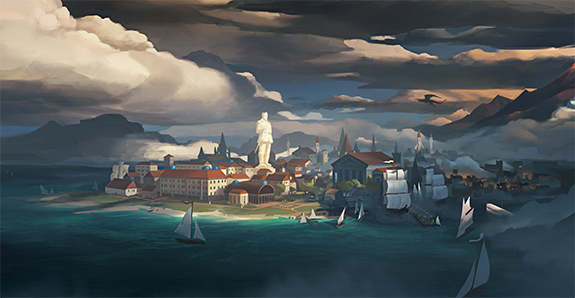
The Rebellion of the Five Houses was a successful and mostly bloodless insurrection against the reign of King Rada III which took place in the 6th decade BA (Before the Accord) of Kourend's timeline, orchestrated by the Lords of all five cities of Great Kourend. Directly following the uprising, they established the Council of Elders, which jointly ruled Kourend for a few decades before the transition to a rotating monarchy with the signing of the Royal Accord of Twill.[1] The events of the Rebellion of the Five Houses are narrated in the Extract from Eathram and Rada.
History
Identity of the Rebellious Lords
The insurrection against King Rada III was fomented by a charismatic leader that went by the name of Eathram, described as "a man of hope, a man of truth and innocence" by the anonymous author of the Extract from Eathram and Rada.[2] It was Eathram who convinced the Lords of the various houses to join in his conspiracy: he invited them to a meet at the Tower of Magic to agree upon a course of action, thereby heralding in the rebellion. In the extract their names are given one by one in the same order as they arrived at the gathering, and by cross-referencing these names with those found in Rada's census, we can infer to which house they belonged.[3] First to arrive at the scene was Lord Pecule of House Arceuus; next Eathram himself; followed by Lord Draben of Shayzien; Lord Ferral of Piscarilius; and finally the young Lord Svelgn of Lovakenj.[4] This leaves of course the Lord of house Hosidius: it would seem from this text that Eathram himself assumed that position shortly before the uprising, though we have also reason to believe that his elevation went against the ordinary line of succession. In the census drawn up short years prior, we can find that the fertile lands of Hosidius were ruled over by Lord Horatio, whose wife Lady Loretta bore him an heir equally named Horatio. Yet from the extract we learn that "[t]he world dids't pass from Horatio to Eathram".[5] For reasons unknown, it would thus seem that Eathram was granted lordship over Hosidius, perhaps made possible by a broader dissatisfaction with regard to one of the two Horatio's. If this would be the case, the rebellion could be seen as a popular uprising or peasant revolt, or at least in part, before Eathram joined forces with the rest of the Kourend aristocracy.[6] The fact that Eathram reportedly considered his actions to be predestined might indicate that the uprising had a religious component.[7] There is some indication that Saradominist beliefs are a particular feature of the Kourend lower class, and of the Hosidius peasantry especially.[8][9]
Causes for Discontent
The reign of King Rada III was a short one, having come to power in the 7th decade BA and lasting only a single decade before being overthrown during the Rebellion of the Five Houses in the 6th.[10] It is by and large unknown what caused his deep unpopularity, though we can point to some facts that may hint at the causes. We know that King Rada III had ordered the Tower of Magic be built at some point during his rule, although it is unclear to what purpose.[11] The tower soon became a place of prominence however, evidenced by the Council of Elders choosing it as their seat of power following their rebellion. Given that the tower has at times been used for nefarious purposes (most notably during the reign of King Shayzien VII and later Xeric), it is possible that it might have played some role in provoking the rebellion. What we do know is that his rule is described in starkly negative terms: Eathram was led to pick up arms "through oppression"; their decision to rebel "would combat the evil they faced"; and his address to the people was "not full of mourning but with passion".[12] This last quote might suggest that a great many citizens did in fact succumb in the prelude to the uprising, though it is also possible that the line is directed not at King Rada but at Horatio Hosidius, whom Eathram (presumably) deposed prior to the events of the Rebellion of the Five Houses. Dissatisfaction towards the Lord in charge of agricultural production may point to famine being involved in some shape or form, though if this were the case, it would have been related rather to gross mismanagement than anything to do with the Beast of Winter, as the latter wouldn't surface in Great Kourend until the 2nd decade after the Accord.[13]
The Insurrection
The decision to rebel having been made, Eathram together with the other four Lords assembled a militia comprising of four regiments of phalanx spearmen, together with a hundred knights.[14] With Eathram at the head, the rebellious forces marched on Kourend, prepared to face King Rada III and his forces.[a] It is unknown how many loyalist soldiers awaited them there, as it is likely that a large proportion of them defected to the rebel's side together with Lord Draben Shayzien, and the Royal Guard would not be established until the reign of King Byrne I.[15] Nonetheless, the fact that Eathram marched against his liege not only in the hope for better days but also with "the fear for his enemies carried before him" suggests that the success of the insurrection was by no means felt to be a foregone conclusion.[16] Yet at the sight of the rebel army, the loyalists laid down their arms, and Eathram and his men entered the capital unopposed. Feeling that he had lost his grip on power, and evidently unwilling to face exile or captivity, King Rada III decided to take his own life, putting an end to the line of Rada, the first to unify all of Great Kourend.[17]
Notes
References
| Wars |
| ||||
|---|---|---|---|---|---|
| Battles in Misthalin | |||||
| Battles in Asgarnia | |||||
| Battles in Kandarin and the Fremennik Province |
| ||||
| Battles in Morytania | |||||
| Battles in Forinthry and the Wilderness | |||||
| Battles in the Kharidian Desert | |||||
| Battles in Tirannwn | |||||
| Battles in Kourend |
| ||||
| Battles in Varlamore |
| ||||